A new James Graham play just opened in the West End. A screen adaptation of one of his earlier plays, directed by Danny Boyle, is due out this year, and his television drama Sherwood is about to run its third season. Something is certainly working for the writer who extracts the kernel of drama from Britain’s institutions.
No other British playwright working today has made the inner workings of Parliament, Fleet Street and football management feel like essential drama the way James Graham has. It isn’t a trick he’s pulled off once, it’s something he’s done again and again, building one of the most distinctive, and most genuinely popular, bodies of work in contemporary British theatre in the process.

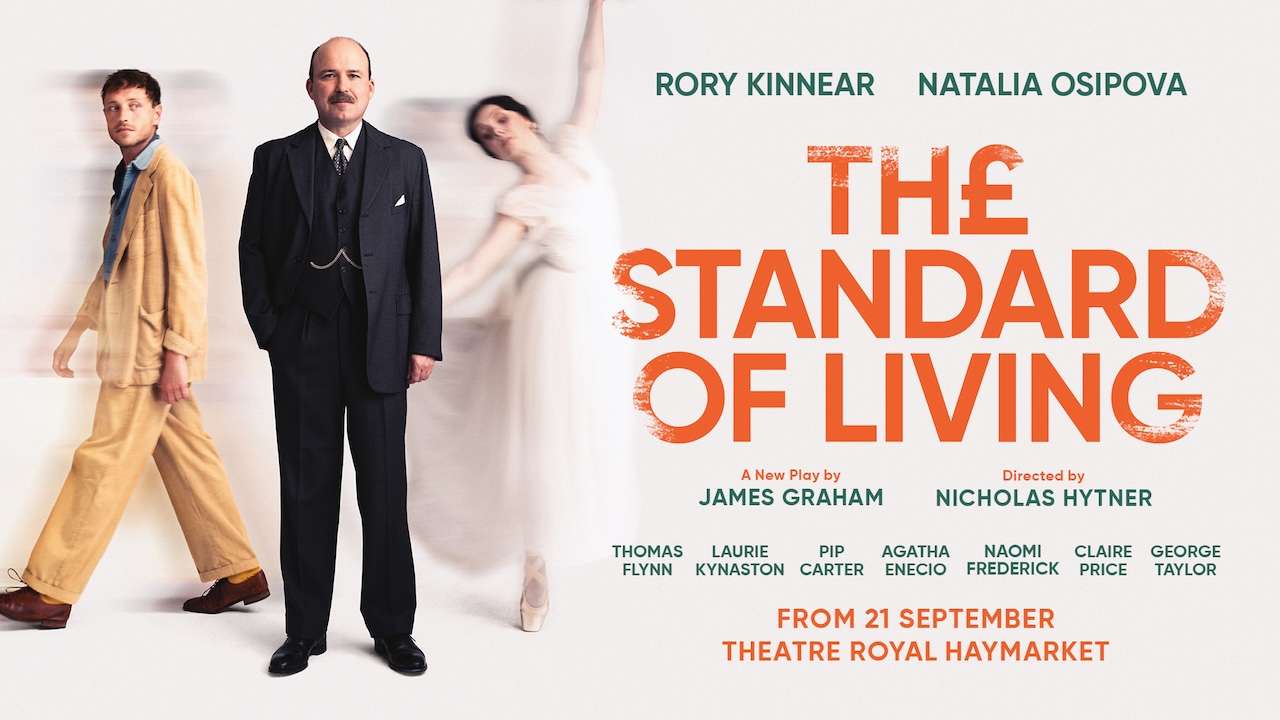
Right now, he’s doing it three times at once. A new play about the Treasury’s most famous economist – The Standard of Living – is in the West End. A screen adaptation of one of his earlier plays, Ink directed by Danny Boyle, is due out this year. His television drama Sherwood is in post-production on its third season.
All three from one writer, diving into the nitty gritty in subjects that rarely get treated as obvious drama: parliamentary procedure, a quiz show scandal, post-war fiscal policy, the launch of The Sun, each transformed into a vibrant and personable piece of work that’s as far away from the dry tone the subject might suggest.
Finding the human story inside the process

Making these institutions into the kind of stagecraft that has gripped audiences and won a slew of awards alongside, is no easy task. The trick if there is one? Extracting the reality of the people trying to make each institution work, and what that effort costs or reveals about them.
This House, Graham’s 2012 National Theatre breakout, turned the whips’ offices of a hung 1970s Parliament into a genuinely tense ensemble drama. It was later voted the best play of the 2010s by publisher Methuen.
Punch, which transferred from Nottingham Playhouse to the Young Vic, the West End and then Broadway, tells the true story of Jacob Dunne, who killed a stranger with a single punch, and his path through restorative justice toward an unlikely relationship with his victim’s parents. In it, Graham scrutinises system that asks a guilty young man and two grieving parents to do something genuinely difficult together, and the drama comes entirely from watching them try.
Ink did the same for Fleet Street, dramatising the launch of The Sun under Rupert Murdoch as a story about ambition curdling into consequence, and won Graham an Olivier. Quiz took a real television scandal, the “coughing Major” Who Wants to Be a Millionaire? cheating case, and found in it a sharp piece of writing about reasonable doubt and media trial by spectacle.

And Dear England, his most recent Olivier winner, turned Gareth Southgate’s England tenure into a study of institutional culture and the slow work of trying to change it.
In each case, the institution or system is the hook, but the engine of the drama is the ordinary people inside it, that are trying to do something decent, often against the system’s own grain.
A harder institution to dramatise

That instinct meets a genuinely different kind of subject in The Standard of Living, Graham’s new play about the economist John Maynard Keynes, and the reviews, warmer from some critics than others, are a useful way into why.
Part of what seems to be happening is that economic theory resists the format that’s worked so well for him elsewhere. Parliament, a newsroom, a dressing room, a quiz show studio: these are settings with built-in conflict, a visible opponent, a clock running down.
Macroeconomic policy is slower and more abstract, and several critics felt that strain directly. The Independent, for instance, found Keynes himself “easier to admire intellectually than to warm to personally,” while the Times pointed to moments of dialogue that tip into exposition, “Hello, Beveridge,” rather than scene.
It’s an interesting tension rather than a verdict on the play: the same method that makes institutional process feel urgent when the stakes are concrete seems to work harder when the stakes are an idea. Whether that’s a limit of the form or just a harder brief, Graham’s next choice of subject will be a useful test either way.
How he got here

Graham grew up in Nottinghamshire during the miners’ strike of the mid-1980s, and has said the experience shaped how he sees institutions long before he started writing about them.
Decisions made in distant rooms had real consequences for people like his own neighbours and family, creating a link between faraway process and local human cost that runs through nearly everything he’d go on to write, well before Sherwood made the explicit connection.
He studied drama at the University of Hull, then returned to Nottinghamshire to work the stage door at the city’s Theatre Royal, where he wrote his first play. His professional debut, Albert’s Boy, was staged at the Finborough Theatre, a small west London venue known for championing new writers, where Graham became playwright-in-residence.
This House, commissioned by the National Theatre under Nicholas Hytner’s artistic directorship, premiered in 2012 in the Cottesloe, the building’s smallest space, before demand pushed it into the much larger Olivier Theatre within months.
It’s a rare trajectory for a play about whips’ offices and backbench rebellions, and it set the template for the plays that followed: the same instinct for institutional drama, has shifted Graham’s penetrating gaze from newspapers to football, television scandal and now economic theory, with television work like Sherwood and Brexit: An Uncivil War running alongside.
What’s next?
Sherwood’s third season is currently in post-production, continuing the BBC drama’s examination of a Nottinghamshire community still shaped by the miners’ strike decades on, the same subject that shaped Graham himself.
Ink’s screen adaptation, directed by Danny Boyle and starring Guy Pearce, Claire Foy and Jack O’Connell, is due for release this year, taking Graham’s Fleet Street drama to an audience many times the size of any West End run.
Whatever subject he turns to next, it’s a safe bet that no one else would have thought to put it on stage, and that he’ll make an audience glad someone did.
Theatre Royal Haymarket, London
Related News

James Graham on hit play Punch: “I’m hoping to turn that into television.”

Pillion and Punch among the big winners at the Sky Arts Awards 2026

West End top picks & new London shows in October 2026

The Standard of Living reviews: “a belter” to some critics, “a colossal yawn” to others
Latest News

A jaunt through the history of panto: how a flexible theatre form transformed Britain’s Christmas theatre scene

Everything you need to know about West Side Story at the National Theatre
10 reasons we can’t wait for West Side Story